Most people come to boxing thinking about their hands. Within a few classes, they find out how much of the work happens below the waist. Your feet decide whether you're balanced when you throw a punch and whether you're standing at the right distance from the bag.
Footwork can look complicated when an experienced boxer does it, but the basics come down to a few simple rules. This guide covers how to move in each direction from your stance, how to change angles around the bag, and some drills to practise in class or at home. Brand new boxers should start with their stance and jab first, then come back to this once those feel familiar.
The one rule that covers most footwork
Boxers move with what's often called a step-drag. The foot closest to the direction you want to go moves first, and the other foot follows the same distance. Then you're back in your stance.
That means:
- Moving forward: your lead foot steps first, then your rear foot follows.
- Moving back: your rear foot steps first, then your lead foot follows.
- Moving towards your lead side: your lead foot steps first. For an orthodox boxer with the left foot forward, that's moving left.
- Moving towards your rear side: your rear foot steps first. For an orthodox boxer, that's moving right.
If you box southpaw, with your right foot forward, everything is mirrored. Your right foot leads when you move right, and your left foot leads when you move left.
The steps are small, usually no more than a short shuffle. Big steps pull your stance out of shape and leave you briefly off balance, which is when a punch loses its power.
Keep your stance the same width
The aim of footwork is to arrive in the same stance you started in. After every step, your feet should be about shoulder-width apart, staggered, with your knees slightly bent.
Two things tend to go wrong. The first is your feet drifting together as you tire. That makes you top-heavy and easy to tip over. The second is your feet ending up in a straight line, one directly in front of the other, which makes it hard to balance side to side. A quick glance down between combinations lets you spot it and reset your feet before the next one.
Never cross your feet
Crossing one foot over the other is the most common footwork mistake in a beginner class. It usually happens when moving sideways, where people walk the way they would in the street. Midway through the step, you're standing with your legs twisted and almost no base. If you threw a punch from there, you'd lose your balance.
The step-drag rule fixes this. Lead with the foot closest to where you're going, and your feet never pass each other.
Stay light on your feet
Keep your weight on the balls of your feet with your heels just slightly raised. You don't need to bounce up and down constantly. Small, light steps are more efficient and much easier on your calves.
Keep a slight bend in your knees throughout. Locked knees make every movement slow and jerky.
Changing angles with a pivot
A pivot lets you change the direction you're facing without stepping away. Keep your lead foot planted, push off the ball of your rear foot and swing it around in an arc, turning your body with it. Orthodox boxers usually pivot to the left, which turns them around their lead foot.
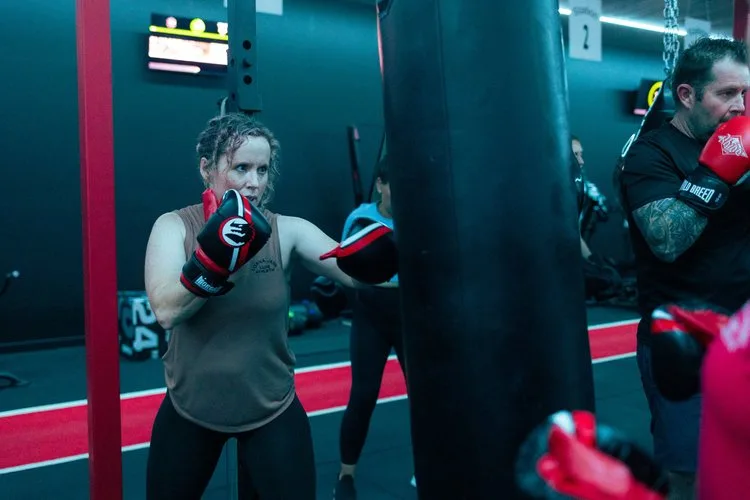
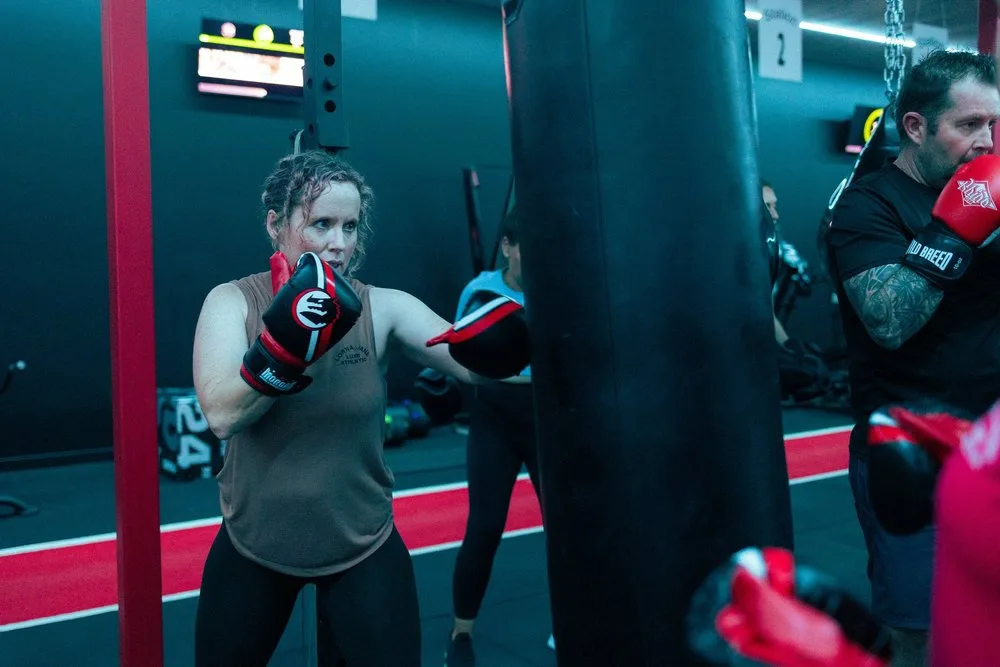
On the bag, a pivot lets you work from a new side rather than standing square in front of it the whole round. It's also a good habit for keeping your hips and shoulders turning together.
Don't confuse this with the rear-foot turn you use to throw a cross. That's a smaller rotation on the spot for power. A pivot changes your whole position.
Circling the bag
Many bag rounds include moving around the bag between combinations. A simple pattern is to throw a combination and then take two small steps sideways using the step-drag. Set your feet before you throw again.
Keep your guard up while you move. Your hands often drop as soon as you start thinking about your feet. Keep your eyes on the bag rather than the floor, too. It feels strange at first, but you'll know where your feet are without looking after a few sessions.
Punching while you move
As a rule, you want your feet set when a punch lands. Beginners should step, then punch, then step again, rather than trying to do both at once.
The exception is the step jab, where your lead foot steps forward as your jab extends. Your rear foot then slides up to rebuild your stance. Once that feels comfortable, you can start adding a step back after a combination, which teaches you to move out of range rather than staying planted in one spot.
Four drills to practise
Line drill
Put a strip of tape or a rolled towel on the floor and stand in your stance with one foot on each side of it. Step forward and back along the line, then move sideways using the step-drag. Check that your stance stays the same width and that your feet never pass each other.
Shadow footwork rounds
Set a timer for two minutes and move around a clear space in your stance, hands up, without punching. Call out directions to yourself if it helps. Then add a jab after every few steps.
Mirror drill with a partner
Face a partner, both in stance. One person leads by moving around the space. The other mirrors them to keep the same distance. Swap after a minute. It's a good way to make your reactions quicker.
Bag circles
On the bag, throw a 1-2 and then step sideways twice. Pivot before the next 1-2. Go one way for a round and the other way for the next.
Footwork and fitness
All this movement adds up. Your legs do a lot of work in a round, even when your arms feel like the part that's burning. If your Myzone heart rate climbs higher than expected in a technical Box class, footwork is often why.
Anyone with ankle or knee problems should check with their GP or physio before adding lots of lateral movement. Let your trainer know as well. Smaller steps and more time between movements are easy adjustments.
Practise footwork in Box
Your trainer can spot crossed feet or a collapsing stance in a second, which is hard to do on your own. Box classes focus on skill, so they're a good place to practise moving well. Find a Box class on the timetable. If you're new to MPower, the membership page has details of the 2 weeks free offer for a limited number of new members, including unlimited classes, free boxing gloves, a free Myzone heart rate monitor and a $0 joining fee.