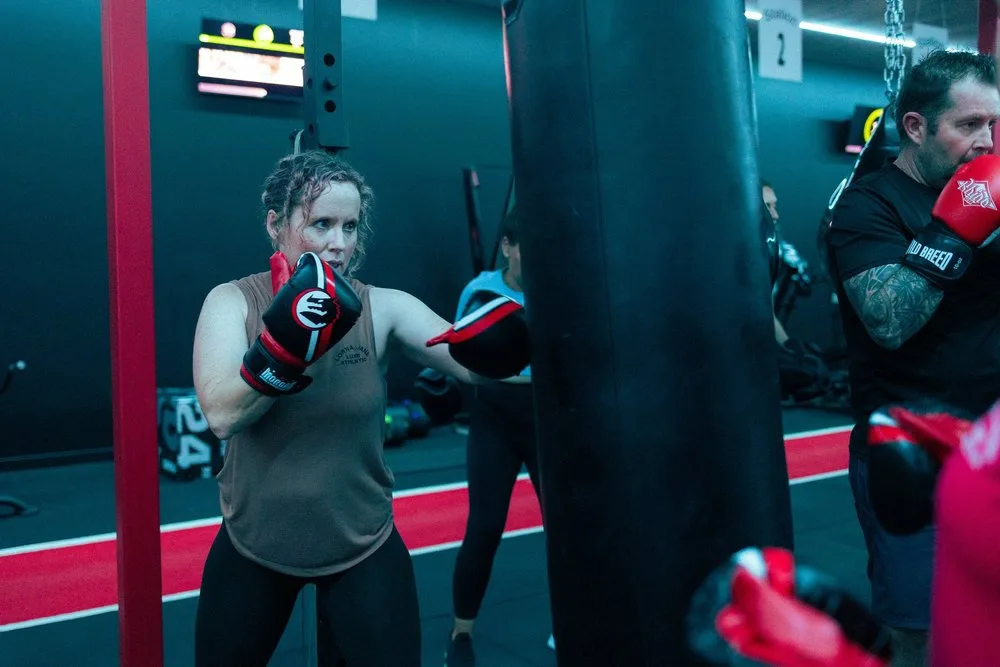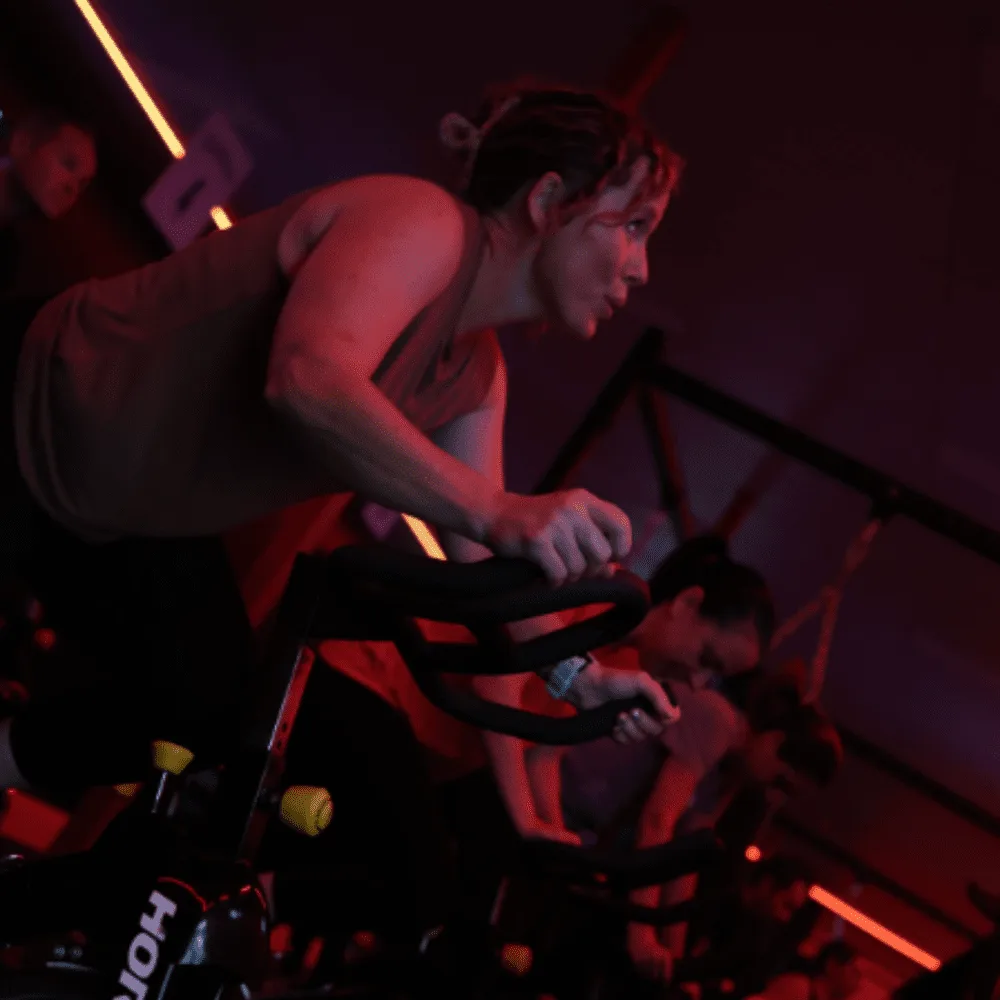
There's a point in most hard classes where your body is working fine but your mind starts negotiating. It might be the final round of bag work, or the last push on the bike in a Burn session. Your shoulders are burning and the timer seems to have slowed down. A voice in your head starts suggesting you ease off and stop for a bit.
That voice isn't always wrong, and later in this article we'll cover when you should listen to it. Much of the time, though, it's speaking up well before you've reached any real limit. Learning to work with it is a skill, and like any skill it improves with practice.
Why your mind wants out before your body does
Hard exercise is uncomfortable by design. Your breathing speeds up and your heart rate climbs. Your muscles fill with that heavy burning feeling. Your brain reads those signals and, quite sensibly, nudges you towards stopping.
For most people, that nudge arrives early. It's a protective habit, and it's especially strong when an activity is new. The good news is that with regular training, the sensations that once felt alarming become familiar. You learn what "hard but OK" feels like, and the urge to stop gets easier to manage.
Shrink the round
One of the most effective tricks is to stop thinking about the whole round. A full round can feel enormous when you're already tired. Ten punches doesn't.
Break the work into the smallest piece you can manage:
- On the bag, commit to the next combination your coach calls, then the next one.
- On the bike, aim for the next 15 seconds rather than the remaining two minutes.
- At a strength station in Build, focus on the next rep with good form, not the total.
- When the timer is counting down, pick a landmark, such as the halfway beep, and only think about reaching it.
This works because the question changes. Asking yourself to keep going for two more minutes invites a no. One more combination almost always gets a yes, and a string of yeses gets you to the end of the round.
Give your mind a job
A tired mind left to wander tends to drift towards how much everything hurts. Giving it a specific task keeps it busy with something more useful.
Technique cues are perfect for this. In a Box class, you might repeat a simple cue to yourself on every punch, such as "hands up" or "turn the hip". Our trainers teach real technique in every session, so you'll pick up plenty of these. In Build, the cue might be "chest up" or "slow on the way down". These short phrases keep your form sharp at the exact moment fatigue tends to make it sloppy.
What you say to yourself matters
Self-talk can sound a bit fluffy, but there's good evidence behind it. A 2011 review of 32 studies, published in the journal Perspectives on Psychological Science, found that practising self-talk improved sports performance. The effect was stronger for new tasks than for well-learned ones, which makes it especially relevant if you're new to boxing.
Two styles of self-talk are worth trying:
- Instructional, which tells you what to do. "Guard up." "Breathe out." "Drive through the legs."
- Motivational, which keeps your effort up. "Keep going." "You've done this before." "Strong finish."
Choose one or two phrases before class so you're not searching for words when you're puffing. Say them in your head, or under your breath if that helps. Swap any harsh lines, such as "I'm hopeless at this", for something that gives you a direction instead.
Use your breath as an anchor
When the work gets hard, many people hold their breath or start taking short, shallow gulps. That makes everything feel worse. In boxing, a sharp breath out on each punch is part of good technique, and it also gives you a steady rhythm to hold on to.
Between rounds, try a few slow breaths with a longer breath out than in. It won't fix fatigue, but it helps you settle and get ready for the next effort instead of spending the rest period worrying about it.
Let the room carry you
Training in a group helps in the hardest moments. The music and the coach counting down give you something outside your own head to focus on. So do the people around you, all working through the same round. When you're struggling, it can help to match the rhythm of the bag next to you for a few seconds, or simply tune into the coach's voice.
Our trainers are also there for exactly this. They'll often notice when you're fading and give you a cue or some encouragement. If you need to scale something back, they'll show you how.
Know your numbers
Myzone gives you live feedback on your effort, based on your own heart rate zones. That's useful in two ways when a round gets tough.
First, it can show you that you're working much harder than you think, which can be a real confidence boost when your legs are wobbly. Second, it gives you an objective check against your head's stories. If the voice is saying you can't go on but your effort is steady and you feel otherwise OK, you can probably keep going a little longer.
When you should stop
Pushing through normal discomfort is part of training, and some signs mean you should stop. Step aside and tell your coach straight away if you notice any of these:
- chest pain or tightness
- dizziness or feeling faint
- sharp or sudden pain in a joint or muscle
- unusual shortness of breath that doesn't settle with rest
- nausea that comes on suddenly
If you have a heart condition, are pregnant, are returning after an injury or haven't exercised in a long time, check with your GP or physio before you start. Let your trainer know on the day so they can help you modify.
There's also a difference between finding your limits and ignoring your body on a bad day. When you're unwell or truly exhausted, the smart choice is an easier session or a rest day.
Practise it like any other skill
You won't nail all of this the first time. Pick one tool, such as shrinking the round, and use it in your next class. Add a cue word the week after. Over a month or two you'll build your own set of tricks for the hardest minute of a session, and that's a skill you'll find yourself using outside the studio too.
If you'd like a place to practise, every MPower class is coach-led and beginner-friendly. We're offering a limited number of new members their first 2 weeks of unlimited Box Build & Burn classes free, along with free boxing gloves to keep, a free Myzone heart rate monitor and a $0 joining fee. Check the timetable for a time that suits, then claim your 2 weeks free.